Flashcards fail for two ordinary reasons. The cards are too big, and the reviews never become a habit. Write one thing you can actually recall, try to recall it before you look, and come back before it fades.
This post is that method, then how to keep the due pile small in Leitiq. What each plan's buttons do is in How Session Leitner works in Leitiq, How FSRS interval repetition works in Leitiq, and Leitner System vs Spaced Repetition.
One idea, one short answer
A card should ask for one fact, one word, or one step, and the answer should be something you can say in one breath: a date, a term in your own words, a formula, a translation. If the back is a paragraph, you skim it, it looks familiar, and you move on without knowing whether you could have produced it.
This prompt has no single answer:
What were the causes of the French Revolution?
"Inequality" will feel close enough. Split it:
- What financial crisis pushed the French crown to call the Estates-General in 1789?
- What voting rule did the Third Estate demand at the Estates-General of 1789? (One vote per deputy, not one vote per estate.)
Same topic. Each card has a line you can mark right or wrong, so a miss tells you which piece failed. Length works the same way. "Mitochondria produce ATP" can be checked. "Discuss the role of mitochondria in cellular respiration, including the electron transport chain" cannot.
Two habits keep cards at that size:
- Ask for a precise piece. "Capital of Canada?" is a card. "Tell me about Canada" is a tour.
- Put the context on the front and leave the back as the missing piece. "In
E = mc², what doescstand for?"
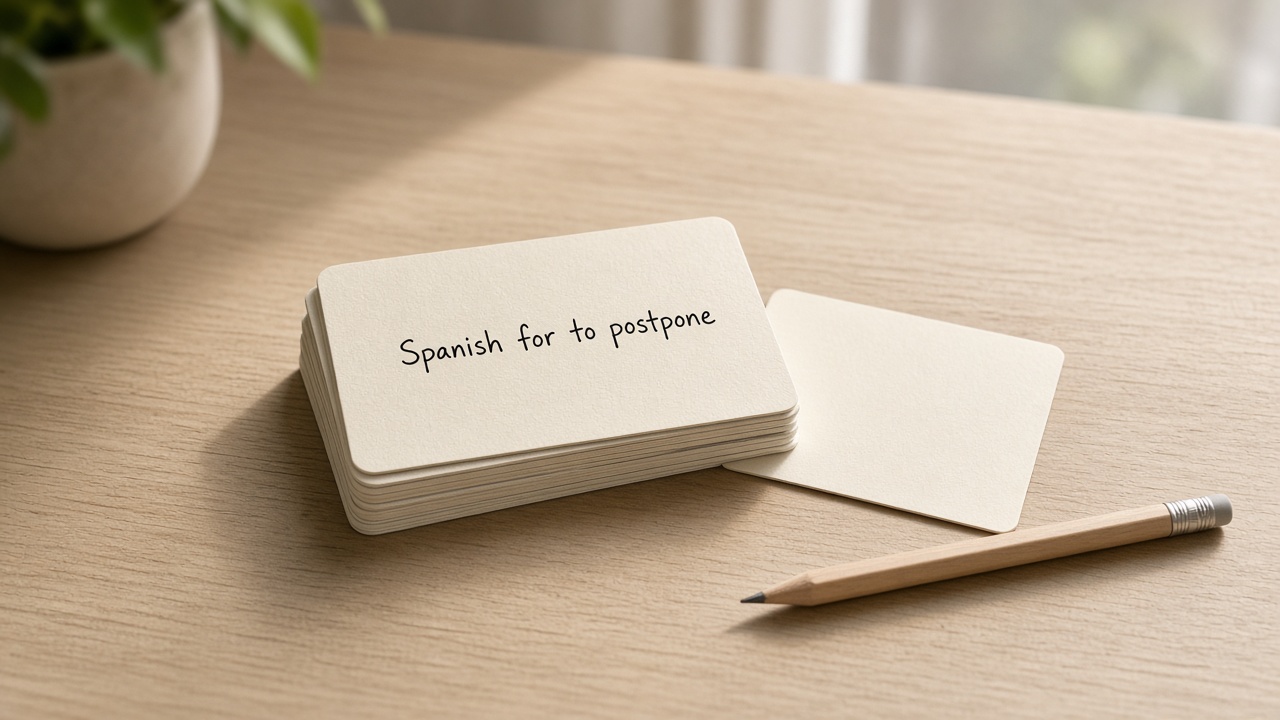
Do the same with vocabulary. "Useful Spanish verbs about time" is a list. "Spanish for to postpone" is a card. If you hesitate about how to split a note, split it. A short card is easy to repair later.
If you cannot tell, after one look, whether you got it right, cut the card or split it before you study it.
Recall before you flip
The useful moment is the pause before the answer. You either pull the idea out, or you notice that you cannot. That attempt is the testing effect: retrieving a fact strengthens it more than reading it again.
Roediger and Karpicke showed this with prose passages in 2006 (Psychological Science). People who reread a passage remembered more five minutes later. They also predicted they would remember it better a week on. A week later the pattern had flipped: repeated testing recalled about 61% of the passage, repeated reading about 40%, and the tests had given no feedback.
Say the answer out loud, or finish the sentence in your head, then reveal. In Leitiq the front stays up until you flip it: Space on a keyboard, or a tap on a phone. Grade the attempt you made before the answer was visible.
Review on a rhythm
Coming back with time between reviews is the spacing effect. Hermann Ebbinghaus measured both that and the forgetting curve in 1885, memorizing lists of nonsense syllables (Memory, translated into English in 1913). Forgetting was steep at first, then slowed. For a short list, 38 repetitions spread over the three preceding days let him relearn it about as easily as 68 repetitions crammed into the day before. He noted that those counts came from few trials, and that the gap was still large enough to favor spacing over cramming.
You need a pile that returns, more than you need a perfect system on the first day. Flat review sorts a short list into known and not-yet. Session Leitner is a study day you can finish. Interval repetition gives each card its own next date. Any of the three works if you actually come back.
Today's sessions is that pile across your decks. A short session most days holds up better than a long one you dread. If a number helps you show up, set a weekly goal for cards you study — cards you review, not cards you add.
Don't add hundreds of cards at once
A large import feels like progress. The reviews arrive later, and a week away makes the queue hard to open. Add a small batch and study it before you write the next one. If this week's cards are still unsteady, wait.
Leitiq already keeps one sitting finite: new cards are held back, and a Leitner box that is ready for review comes before more new ones. How many new cards that is, and when a box takes priority, changes with the plan. Those rules are in the Session Leitner and interval repetition guides.
When you forget an answer
Forgetting a card means the review caught a gap while it was still easy to repair. Ask one question: did you remember the answer before you flipped? Mark that, then move on. Staying on a card until you can recite it for the next few minutes usually means you miss it again next week.
In Leitiq a miss is not a penalty. The card comes back sooner, while the correction is still easy to use. How that return is recorded is in the interval repetition and Session Leitner guides.
If the same card keeps failing, rewrite it before you decide your memory is the problem.
- The prompt is vague.
- The answer is a paragraph.
- Two facts are glued together.
- The wording is someone else's.
Clarify the prompt, shorten the answer, split the card, or rewrite the back in words you would actually say.
This card will keep failing, because nothing on the back can be marked right or wrong:
What is photosynthesis?
Rewrite it to the fact you actually missed:
What gas do plants release during photosynthesis?
Oxygen.
The next review tests that version.
A routine you can keep
- Write a few cards. One idea each. An answer you can say in a breath.
- Study by trying to recall before you flip.
- Clear what is due. Stop when that pile is done.
- When a card fails twice for the same reason, rewrite it before you add anything new.
Those steps only work if you keep coming back.