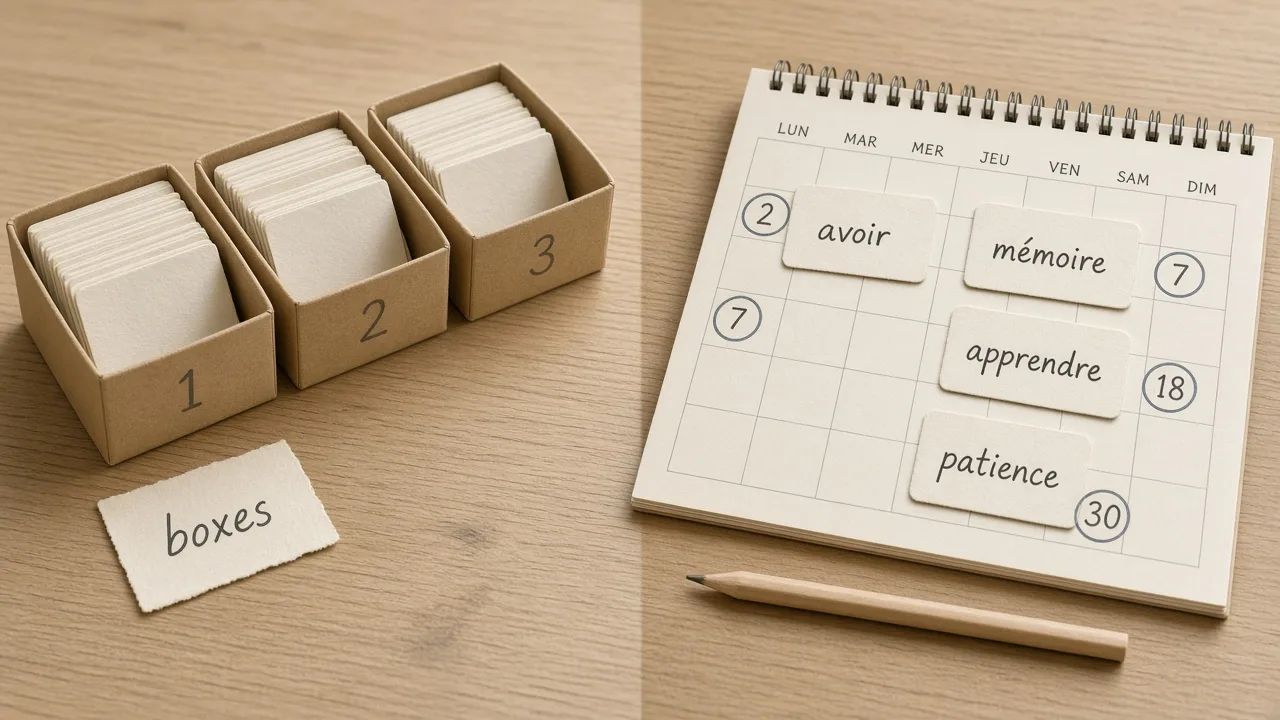
People comparing FSRS with the Leitner system are usually choosing a study plan, and a lot of the advice treats the two names as if one had replaced the other. Both space your reviews, so familiar material waits and shaky material comes back sooner.
Choose Leitner if you want a study session with a clear stopping point. Choose FSRS if you want each card to come back on its own schedule, based on how well you remembered it.
Anki users meet FSRS as the scheduler beside SM-2, the formula Anki used for years. Leitner is older and separate: a paper-card method Sebastian Leitner published in 1972, in So lernt man lernen.
How Leitner and FSRS schedule reviews
In Leitner's method, a card you know moves one box to the right. A card you miss returns to the first box. That reset keeps cards you only partly remember from staying in a higher box. Higher boxes are reviewed less often, and a card's history is simply which box it is in.
FSRS, the Free Spaced Repetition Scheduler from Jarrett Ye and the open-spaced-repetition project, gives each card its own schedule. Leitiq runs FSRS-6, using default weights fit to a large public collection of real review logs. Each grade updates that card's memory estimates. Stability is how long the memory should last before your chance of recall falls to your target, 90% unless you change it. Difficulty is how slowly the card gains stability, so the same Good answer stretches a hard card less than an easy one. The next review date is calculated from those estimates, from how long it has been since you saw the card, and from the target. Over time, cards that would still share a Leitner box can end up on very different dates, depending on the grades you gave them.
How grading affects the next review
Leitner asks only whether you produced the answer. A miss in a high box sends the card all the way back to the first.
FSRS uses four grades. Again means you could not produce the answer. By default the card comes back after about ten minutes, so you can review it again in the same sitting, and the longer interval shrinks. Hard means you did produce the answer, with effort. The next interval is shorter than an ordinary success, and the review still counts as remembered. Good is that ordinary success. Easy means the answer came immediately, and the next date is pushed further out than Good.
Pressing Hard because a card felt unpleasant keeps its intervals short. Pressing Again because recall took effort schedules another review for a card you had already remembered.
What a study session looks like
Leitiq's Session Leitner plan is a pile you can finish. New cards enter in batches of 25 by default, and a learning box is reviewed once it holds 50 cards. On a short deck, lower that capacity toward 10–20 so those reviews happen in smaller batches, instead of waiting until the main pile is empty. If your answers fill the next box in the middle of a pile, you review that box before returning to the cards you paused. Call it a day saves the result: intake cards you knew move up, and any card in today's queue that you never reached counts as a miss.
An FSRS session is the cards whose date has arrived, plus at most 20 new cards a day across all of your interval decks and at most 200 reviews. A successful grade schedules the next date and moves you on; only Again keeps the card in today's short-term loop. By default a miss comes back after about ten minutes, which may be after you have stopped. Closing a Leitner day marks every skipped card as missed. Stopping an FSRS session early leaves ungraded cards due, unchanged.
Which method should you choose?
A word list, a verb table, or a set of exam terms fits a pile you can finish. Material you want to keep for months fits a date per card, because each pass pushes that card's own interval out. Raising the retention target above 90% shortens those intervals, so the same deck takes more time. The account page sketches that load from your recent reviews before you change the number. Premium can train FSRS-6's 21 weights on your history once you have a few hundred reviews. Before that, scheduling uses the public default weights.
In Leitiq the two methods are separate study plans. Interval repetition rolls the study day at 4:00 in your local time, so a one-day interval from a late-night Good is due at the next study day, not 24 hours later on the clock. Changing the plan later clears that deck's saved scheduling, because a box number and a stability value are different records. The button-by-button guides are How Session Leitner works in Leitiq and How FSRS interval repetition works in Leitiq.
Leitner is the better fit when you will send a missed card back to the start in order to finish the pile. FSRS is the better fit when you will save Again for an answer you could not produce, and let each card wait out its own date.